
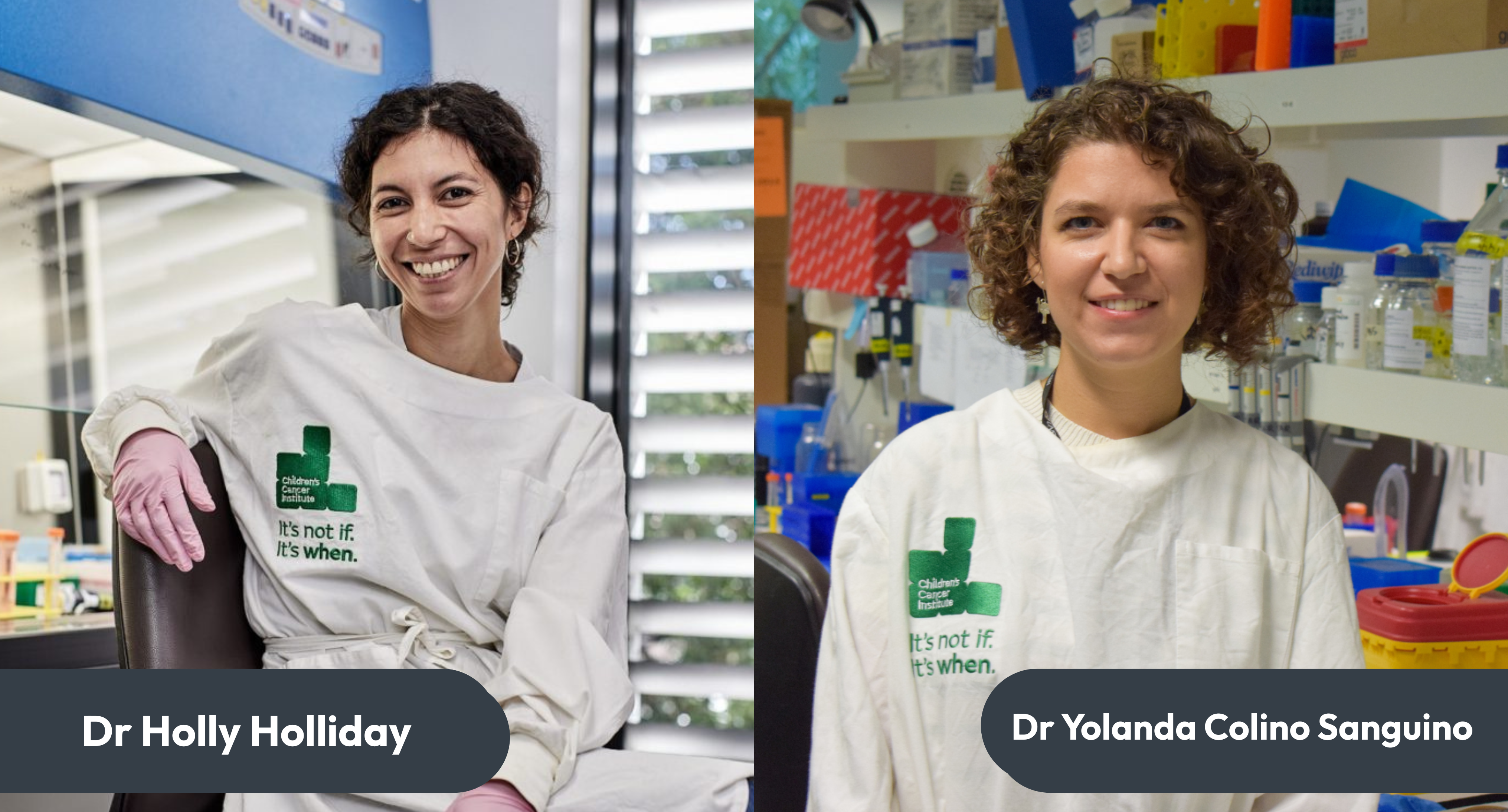
CanToo research alums, Doctors Holly Holliday, Yolanda Colino Sanguino, Fatima Valdes-Mora, and David Ziegler, have reported early findings that may help inform future treatment strategies for one of the most aggressive and deadly brain cancers affecting children – diffuse midline glioma.
Diffuse midline glioma primarily affects children and young adolescents and is extremely difficult to treat, "which means young school-aged children affected by diffuse midline glioma die far too young", explains Dr Holly Holliday, the co-first author of the study.
In the study*, published in Science Translational Medicine, the researchers explored a different approach to this disease. Rather than targeting a single faulty gene, they focused on a broader process that diffuse midline glioma cells rely on to survive and grow – gene regulation (i.e., how genes are switched on and off).
What did the researchers study?
All cells must ‘read’ their DNA to function, a process known as transcription. Diffuse midline glioma cells seem to rely heavily on this process. The researchers looked at two proteins that play key roles in transcription:
- FACT, a protein complex that helps loosen DNA so it can be read, and
- BET proteins, which help keep growth-promoting genes switched on.
Drugs that block FACT or BET proteins already exist, but when used alone, they have shown only limited effects. The study examined whether targeting both simultaneously might be more effective.
What did they find?
In laboratory experiments, combining a FACT inhibitor with a BET inhibitor led to a major disruption of transcription in diffuse midline glioma cells. Thousands of genes that normally promote tumour growth were switched off. As a result, cancer cells were much more likely to stop growing or die with the combination treatment compared to either treatment alone.
In preclinical models of disease, dual treatment slowed tumour growth and extended survival compared with no treatment or either drug alone. The treatment also changed how tumour cells interacted with the immune system, potentially making them more visible to immune attack.

Why is this significant?
The findings suggest that diffuse midline glioma cells have a hidden weakness: their heavy reliance on transcription machinery. By targeting two critical parts of this machinery simultaneously, researchers disrupted tumour growth in ways not seen with single treatments.
While this research is still at an early, preclinical stage, it provides a strong scientific rationale for further exploration of this dual treatment approach and may lead to more effective treatment options for children with these devastating brain tumours.
Thank you for supporting CanToo. We really do rely on people like you to help fund cancer researchers in Australia, like the above.
To make a donation to support our work, please click here.
*You can access the full article for free here.